Over the last few months, I have had the pleasure to work with Dr. Bruce Appleyard and Dan Burden on case studies regarding various livable street projects across the country. It wasn’t until last night’s lecture, however, that our Planning Theory and History class took a deep dive into what a “livable street” really is. Some of the more concrete aspects that we could all agree on were narrower lanes, dedicated bike lanes, plenty of tree coverage, wide sidewalks, low speeds, traffic calming measures, etc. But perhaps the single most important thing that my professor said during the entire night was this: “If you tell an intriguing story, people will slow down”
Practically speaking, this refers to the fact that the more interesting and novel elements that a street has, the more likely people are to drive carefully since they perceive more obstacles that they could potentially run into. But more importantly, it made me think about how our city streets really tell the stories of our lives and of our communities. Do we want our story to be one of wide roads that most would not dare to walk along, let alone cross, for fear of being struck down and killed in an instant? Do we want our story to be that of endless parking lots and concrete slabs without the refuge of a tree’s shade in sight? Do we want our streets, the main mode at which we all travel, to be incompatible with our humanity? Or, do we want our streets to tell the story of a community that values its people over cars?
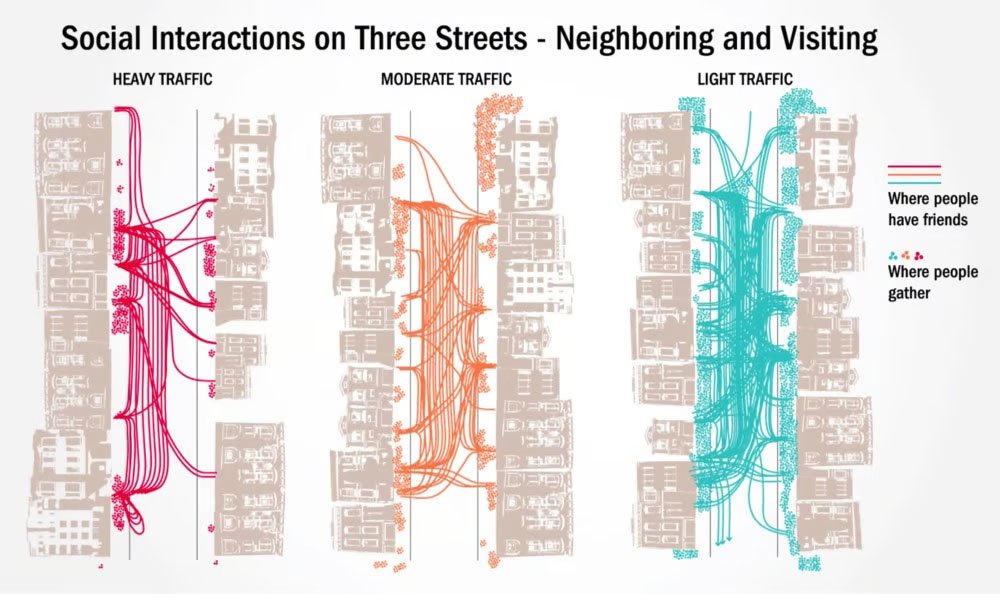
Dr. Appleyard also shared some research from his late father, Donald Appleyard, that illustrated how people in neighborhoods with light vehicle traffic are much more likely to form social connections with their neighbors than those who lived on streets with heavy vehicle traffic. What’s more is that those on lighter traffic streets also viewed nearly the entire street itself as being part of their home territory, whereas those on heavy traffic streets viewed their personal space as just their own building or apartment unit. What this tells us is that planners can, right now, make deliberate decisions that create streets that are worth living on and not just driving through.

